
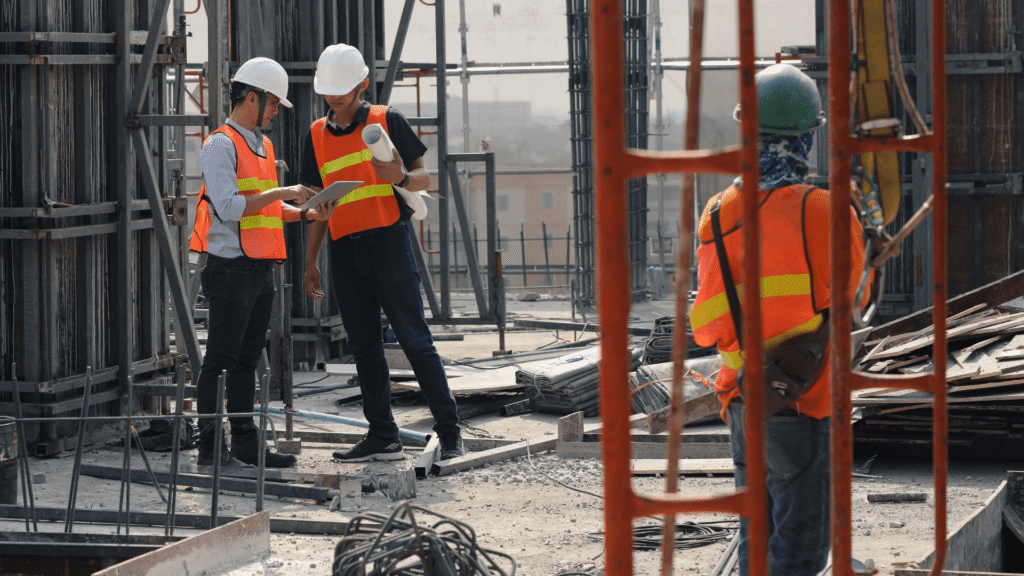
Construction rarely happens at one fixed address. Your employees may start the week at a commercial project, spend the next few days at a residential site, return to the company yard for equipment and then visit a customer location.
For growing contractors, these changing work locations can make workers’ compensation harder to manage. Multi-location workers’ compensation insurance can help businesses organize coverage across multiple job sites while accounting for payroll, employee classifications and different job-site exposures.
The stakes are significant. The U.S. Bureau of Labor Statistics reported 1,034 fatal work injuries in the private construction industry in 2024, more than any other private industry sector.
Why Do Contractors Need Multi-Location Workers’ Compensation Insurance?
Construction companies often operate differently from businesses with one permanent workplace. Employees can move between an office, warehouse, equipment yard and multiple job sites.
That creates challenges involving multiple job sites, high payrolls, subcontractor oversight, claims management and regulatory pressures.
A growing general contractor, for example, might have 10 employees working on three projects. If another project starts, payroll and job duties could change quickly. Keeping your insurer updated can help make sure your policy reflects how your company actually operates.
Accurate employee classifications are especially important. An office administrator generally has different workplace exposures than a roofer, electrician or equipment operator. Mixing classifications or reporting payroll incorrectly can affect premiums and create problems during a workers’ comp audit.
What Is The Difference Between Multi-Location And Multi-State Coverage?
The two terms sound similar, but they address different situations.
Multi-location coverage generally involves a company operating from multiple locations or job sites within one state. Multi-state coverage involves employees working across state lines.
That distinction matters because workers’ compensation is primarily regulated at the state level. Requirements can change when your company expands from California into Nevada, Arizona or another state.
A contractor working throughout California may therefore have very different insurance needs from one regularly sending employees to projects in several states.
How Does Multi-Location Workers’ Comp Work For Contractors?
Depending on the insurer and policy, multiple covered locations can be managed within one workers’ compensation program rather than treating every address as an entirely separate insurance relationship.
The insurer may need information about:
- Each business location and job site
- Payroll and employee headcount
- Work performed by employees
- Employee classifications
- Subcontractor relationships
- Changes in operations or exposures
Consider a concrete contractor with an administrative office in Sacramento, an equipment yard nearby and active projects in several California cities. The office staff, drivers and field crews don’t face identical risks. Accurate records allow the insurer to better understand those differences.
Certificates of insurance also matter. General contractors, property owners and project managers may request proof of coverage before workers can enter a job site. Contractors should also have a process for collecting and reviewing required insurance documentation from subcontractors.
Why Does California Require Extra Attention?
California contractors face specific workers’ compensation requirements.
Employers generally must carry workers’ compensation coverage for employees, while contractor licensing rules add another compliance layer. Current California Contractors State License Board rules require certain license classifications—including C-8 Concrete, C-20 Warm-Air Heating, Ventilating and Air-Conditioning, C-22 Asbestos Abatement and D-49 Tree Service—to maintain workers’ compensation insurance even if they report having no employees. Under current law, broader requirements for licensed contractors are scheduled to take effect January 1, 2028, subject to future legislative changes.
These requirements matter when a small contractor grows. Hiring a first employee, adding crews or expanding operations can change insurance obligations quickly.
California construction also carries meaningful workplace exposure. In 2024, the state’s construction industry recorded a fatal work-injury rate of 6.2 per 100,000 full-time-equivalent workers.
What Does Multi-Location Coverage Look Like In The Real World?
Imagine a California electrical contractor that starts with one owner and a small crew. As business grows, the company opens a warehouse, hires more electricians and begins running crews at six customer projects simultaneously.
Now there are more employees, more payroll, different work environments and more subcontractors to oversee.
A strong insurance program should evolve with those changes. The contractor should maintain accurate payroll and classification records, report relevant operational changes, keep certificates organized and work with an insurance professional who understands construction exposures.
The same principle applies beyond construction. Manufacturers adding facilities, restaurant operators opening new locations and blue-collar service companies expanding their territories can face similar insurance-management challenges.
Bottomline: How IRONCLAD Helps Businesses With Multiple Locations
Growth shouldn’t mean juggling insurance without knowing whether your coverage still fits your operations.
IRONCLAD helps contractors, manufacturers, restaurants and blue-collar businesses find custom-built business insurance solutions based on how they actually operate. That means looking beyond a generic policy and considering locations, payroll, employee classifications, job-site exposures, subcontractor relationships and plans for growth.
For contractors managing multiple crews and locations, the goal is simple: make workers’ compensation easier to manage while helping protect employees and the business as operations expand.
Talk with IRONCLAD about building a workers’ compensation solution around your locations, workforce and business needs.